
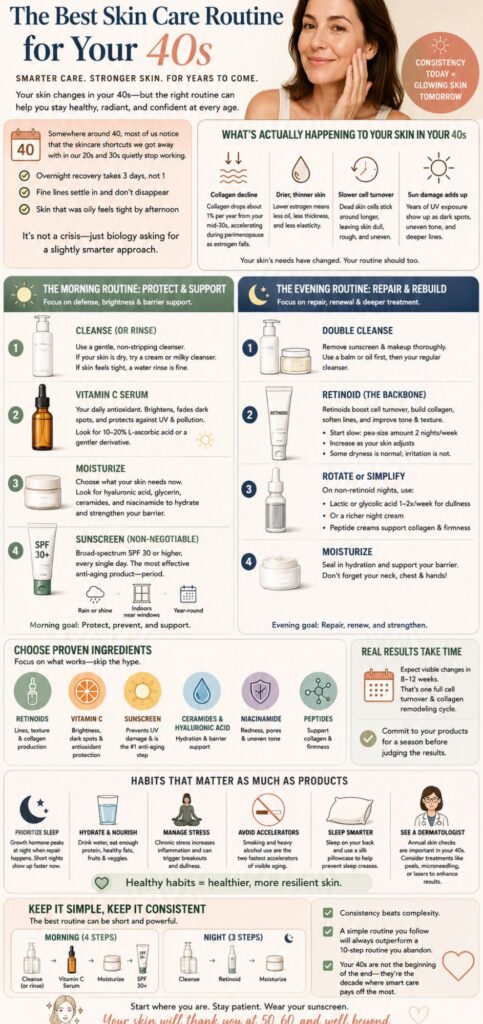
Somewhere around 40, most of us notice that the skincare shortcuts we got away with in our twenties and thirties quietly stop working. The overnight recovery after a late night takes three days instead of one. Fine lines that used to disappear by lunchtime start settling in. Skin that was once oily now feels tight by mid-afternoon. None of this is a crisis — it’s just biology asking for a slightly smarter approach.
The good news is that the best skin care routine for 40s skin isn’t complicated or expensive. It’s about doing a handful of things consistently and choosing ingredients that actually address what’s changing underneath the surface. Here’s how to build that routine, step by step, along with the products and habits dermatologists keep coming back to.
What’s Actually Happening to Your Skin in Your 40s
Before choosing products, it helps to understand what you’re working with. From your mid-thirties onward, collagen production declines by roughly one percent per year, and that loss accelerates around perimenopause as estrogen levels shift. Estrogen supports collagen, skin thickness, and natural oil production, so as it drops, skin tends to become drier, thinner, and less elastic. Cell turnover also slows down, which means dead skin cells hang around longer, leaving the surface looking duller and rougher than it used to.
On top of that, decades of accumulated sun exposure start showing up as dark spots, uneven tone, and deeper lines. This is why a routine that worked at 30 can feel useless at 45 — your skin’s needs have genuinely changed, and your products need to change with them.
The Morning Routine: Protect and Support
Mornings are all about defense. Start with a gentle, non-stripping cleanser. If your skin has gotten drier, a cream or milky cleanser is usually more comfortable than a foaming gel. Some dermatologists even suggest skipping cleanser in the morning entirely and just rinsing with water if your skin feels tight — there’s no rule that says you must foam up twice a day.
Next comes the workhorse of any dermatologist recommended skin care routine for 40s and beyond: a vitamin C serum. Vitamin C is an antioxidant that helps neutralize the free-radical damage caused by UV light and pollution, brightens dull skin, and fades dark spots over time. Look for a stable formulation, ideally with 10 to 20 percent L-ascorbic acid or a gentler derivative if your skin is sensitive. Give it a minute to absorb, then follow with a moisturizer that suits your current skin — not the skin you had ten years ago. Ingredients like hyaluronic acid, glycerin, ceramides, and niacinamide help pull in hydration and reinforce a skin barrier that naturally weakens with age.
The final morning step is non-negotiable: sunscreen, every single day, rain or shine, indoors near windows or out. A broad-spectrum SPF 30 or higher is the single most effective anti-aging product ever made, and it costs a fraction of what most serums do. Nothing else in your routine will matter much if UV damage keeps outpacing your repairs.
The Evening Routine: Repair and Rebuild
Nighttime is when skin does its repair work, so this is where your active ingredients earn their keep. Begin by properly removing sunscreen and makeup — a double cleanse with a balm or oil first, then your regular cleanser, works well if you wear anything heavier than SPF.
Then comes the ingredient nearly every dermatologist agrees on: a retinoid. Whether you choose over-the-counter retinol, retinaldehyde, or prescription tretinoin, retinoids speed up cell turnover, stimulate collagen production, soften fine lines, and improve tone and texture. They are, without exaggeration, the backbone of any serious routine at this stage of life. If you’re new to them, start slowly — a pea-sized amount two nights a week, buffered with moisturizer, then gradually increase frequency as your skin adjusts. Some initial dryness or flaking is normal; raw, irritated skin is not, so listen to your face and back off when needed.
On nights you’re not using your retinoid, you can rotate in a gentle exfoliating acid like lactic or glycolic acid once or twice a week to help with dullness, or simply keep things simple with a richer night cream. Peptide creams are also worth considering here; they support collagen and pair nicely with retinoids without adding irritation. Finish every evening with a nourishing moisturizer, and don’t neglect your neck and chest — they age right along with your face and are usually years behind on care.
Choosing the Best Anti Aging Skin Care Products for 40s Skin
With thousands of products shouting for attention, it’s easy to overspend on things that don’t matter. When shopping for the best anti aging skin care products for 40s skin, focus on proven ingredients rather than brand hype: retinoids for lines and texture, vitamin C for brightness and spots, sunscreen for prevention, ceramides and hyaluronic acid for barrier support and hydration, niacinamide for redness and pores, and peptides for firmness. A routine built from those six categories covers virtually everything that matters, and excellent versions of each exist at drugstore prices.
Be a little skeptical of products promising to “erase” wrinkles or work “instantly.” Real change in skin takes eight to twelve weeks of consistent use, because that’s how long a full cell turnover and collagen remodeling cycle takes at this age. Pick your products, commit to them for a season, and judge the results then — not after five days.
Habits That Matter as Much as Products
No cream can out-perform a lifestyle that works against your skin. Sleep is when growth hormone peaks and skin repair happens, so chronic short nights show up on your face faster now than they did at 25. Hydration, a diet with enough protein and healthy fats, and managing stress all feed directly into how your skin looks and heals. Smoking and heavy alcohol use are the two fastest accelerators of visible aging, full stop. Even something as simple as sleeping on your back or switching to a silk pillowcase can reduce the sleep creases that gradually etch into fine lines over the years.
It’s also worth booking an annual visit with a dermatologist if you can. Beyond personalized advice, your 40s are when regular skin cancer checks become genuinely important, and a professional can spot changes long before you would. If you want to go further, in-office treatments like chemical peels, microneedling, or lasers can amplify what your home routine achieves — but they’re an upgrade, not a requirement. Corrective skin care make your Skin better.
Keep It Simple, Keep It Consistent
If all of this feels like a lot, here’s the reassuring truth: the best skin care routine for 40s skin can be as short as four steps in the morning — cleanse, vitamin C, moisturize, SPF — and three at night — cleanse, retinoid, moisturize. Everything else is optional refinement. Consistency beats complexity every time; a simple routine you actually follow will outperform a ten-step regimen you abandon by February.
Your 40s aren’t the beginning of the end for your skin. In many ways, they’re the decade when smart care pays off the most, because you’re finally treating your skin based on what it needs rather than what a trend dictates. Start where you are, stay patient, wear your sunscreen, and your skin will thank you at 50, 60, and well beyond.